
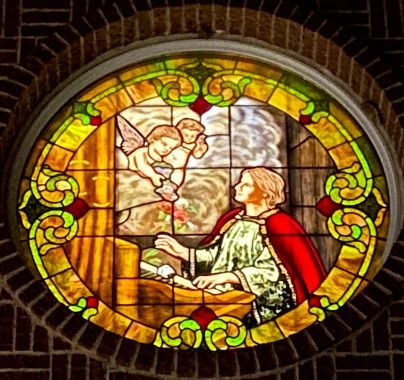
You’ve probably seen an image of St. Cecilia in a stained glass window in a church. She is frequently depicted in a window in the choir loft since she is the patron saint of music and musicians. Often, she is seen playing music on a keyboard instrument like an organ or piano – or sometimes holding another piped instrument (see the Raphael painting of 1514). Angels or cherubs are also often nearby offering their vocal contributions while St. Cecilia gazes upward yearning for heavenly music.
St. Cecilia was a martyr of the 3rd century (~ 230 AD). She was raised in a wealthy family and her holiness was apparent early in her life and she is said to have committed herself to the Lord at a young age. Nonetheless, she was betrothed to a young man, Valerian whom she married, and then converted to Christianity along with his brother Tiburtius. Some say that St. Cecilia sang to God in her heart during her wedding ceremony and the heavenly song caused her to be associated with music and musicians. Other sources tell of her care in singing the divine praises which resulted in her patronage of musicians.
After her marriage to Valerian, the saint maintained her vow of virginity. The newly baptized brothers supported the Christian cause by burying those routinely killed during this period of persecutions – and for this act of Christian charity they were executed. Under the rule of Alexander Severus, the story goes that after the brothers were murdered, St. Cecilia was brought before the prefect who gave her the choice of either sacrificing to the idols or being killed. As her servants begged her to relent, she made this eloquent statement which caused more than 400 to be baptized, “Good folks, I am not losing youth, but exchanging it, giving up clay and receiving gold, abandoning a hut for a palace, leaving a narrow corner of the street for a wide-open, light-filled plaza. If someone offered you a gold piece for a copper, would you not accept it readily? God, indeed, gives back to us a hundred for one.” (page 708 of Jacobus de Voragine’s, The Golden Legend). The angry prefect ordered the executioners to kill St. Cecilia in a bath of boiling water, however, after being scalded for nearly two days, she was not harmed. The prefect then ordered her to be beheaded, but after three chops to her neck, she still lived on for three days during which time she gave away her possessions to the poor and preached to the onlookers.
Although the heroic circumstances of her death may have attracted early followers, through the centuries it has been the imagined sweet sound of the purity of her thoughts and actions in dedication to the Lord which have resulted in her sacred popularity.
She was initially buried by St. Urban in the burial ground of the bishops, but her body was later moved to the Basilica of Santa Cecilia in Trastevere (Beyond the Tiber) in the 9th century. Her feast day is celebrated on November 22.
