
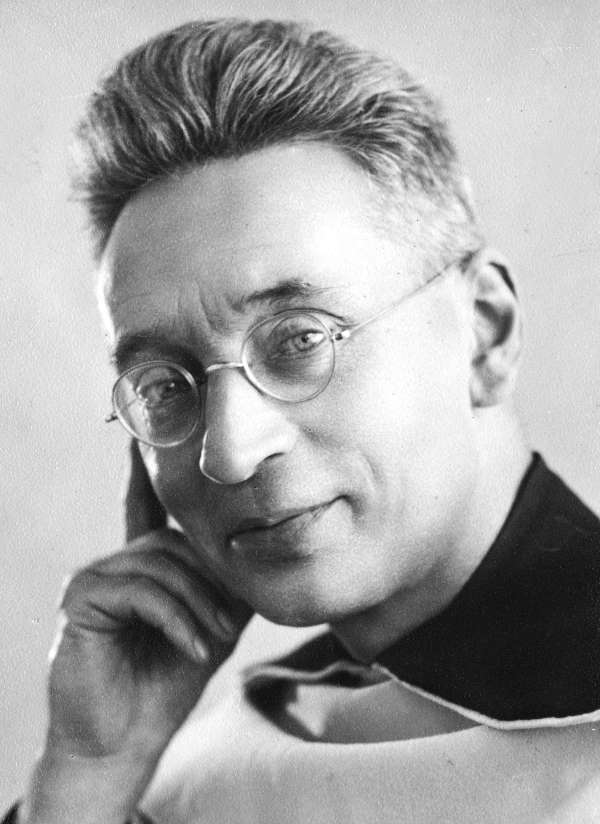
St. Titus Brandsma (1881-1942) was a Dutch Carmelite priest, a University Professor, a journalist; and a leader of the Dutch Catholic Press who was martyred in the Dachau concentration camp in 1942. He is one of the newest Carmelite Saints and was canonized by Pope Francis on May 15, 2022. His Feast Day is on July 27 and he is the patron saint of journalists.
Inspiration as a Contemplative in the World
St. Titus Brandsma serves as a model who accomplished a feat that many do not, that is, living a life exhibiting the practice of his contemplative Carmelite spirituality in the Carmel, and in the world. He exhibited the serenity of being united with Christ in his interactions with others in good times and during periods of great suffering. The sources of St. Titus’ inspiration were many and included Thomas a Kempis’ Imitation of Christ, the examples of the Frisian patron St. Boniface and the writings of the Carmelite Doctor of the Church, St. Teresa of Jesus (of Avila). St. Titus preached that God was within all, and that through acceptance of suffering all can be united with Jesus’ in suffering, and therefore, be grateful, and even joyful in suffering. Some of his philosophy is expressed in his poem, Before the Image of Jesus in Prison – see below.
A Supportive, Religious Family Life Spawned 5 Vocations and a Saint
Anno Sjoerd Brandsma was born on February 23, 1881 in the Frisland region of the Netherlands. His parents (Titus Hendriks Brandsma and Tjitje Postma)(Tjitsje translates to Teresa) were dairy farmers with a deep Catholic faith which they passed on to their children. Anno and his brother Hendrik both became priests, and three of his four sisters became nuns. The parents taught their children with readings each day from the Bible, Imitation of Christ or the Lives of the Saints. The family also prayed the Rosary each day, and attended Mass while Anno served as an altar boy. All of the children attended Catholic Schools and did daily chores on the farm. Anno was an extraordinarily bright child with a near photographic memory although his life-long health issues related to stomach problems and hemorrhages were also becoming apparent. At age 10, he announced that he wanted to become a priest; and at age 12, he entered the Franciscan preparatory school (like a “minor seminary”) in Megen. Anno explored various religious orders including the Franciscans, Trappists and Carthusians. Anno also came to learn about the Carmelites, in part, from his mother’s first cousin, Casmirus de Boer who was about to be ordained as a Carmelite.
A few months before his 18th birthday, Anno began the Carmelite path. He later said, “The spirituality of Carmel, which is a life of prayer and tender devotion to Mary, brought me to the happy decision to embrace this life.” On September 22, 1898, Anno became a Carmelite novitiate and took the name “Titus” in honor of his father, and of St. Paul’s disciple, Titus. After 7 years of formal preparation, Titus was ordained as a priest on June 17, 1905 in the Cathedral of Den Bosch in Brabant.
A Priest, Professor and Journalist
On October 25, 1908, Fr. Titus was able to add “PhD” to his title with a degree from the Gregorian Pontifical University in Rome while still fulling his daily obligations as a priest. As an academic, he was first a professor teaching Carmelite students in Oss before joining the Catholic University of Nijmegen (renamed Raboud University in 2004) in 1923 where he eventually became the Chair of the Philosophy Department and rector magnificus on October 17, 1932. Professor Brandsma was well-liked by his students and taught courses in philosophy and the history of Dutch mysticism. They called him “The Little Professor” and many considered him as a father-figure, friend, and teacher. Fr. Titus contributed several noted academic articles during this time and was also active in journalism. He was the publisher of a magazine called Karmelrozen (Rose of Carmel) and editor-in-chief of a newspaper De Stad Oss (The City of Oss). In 1935, he was appointed as the Ecclesiastical Assistant to the Association of Catholic Journalists which later would allow Fr. Titus to demonstrate his faith at a great personal cost.
As a student in 1901, Fr. Titus began the work which may have been the dearest to him, translating the works of St. Teresa of Jesus (of Avila) into Dutch. He started with a translation of an anthology of her life from French. In 1916, he began the collaborative translation of St. Teresa’s works from Spanish to Dutch. The first of 7 planned volumes, the Book of Her Life, written by Fr. Titus was published in 1918. Three volumes (four volumes by some sources) were completed, including in 1926, the Interior Castle and the Way of Perfection by Fr. Titus and collaborator, Fr. Anastasius van Rijswijck.
Fr. Titus gave numerous lectures, speeches, sermons and wrote publications on Carmelite Mysticism. He lectured at the Catholic University of Nijmegen, as well as for lecture invitations in the Netherlands and throughout the world. In 1935, he traveled to Ireland and the U.S. to give talks on Carmelite Mysticism. These are enlightening lectures describing the Carmelite history and devotions starting with the Prophet Elijah (Elias) who is considered to be the Founder of the Carmelites. The order became officially known as the Order of the Brothers of Our Lady when the order was admitted to the west by Pope Innocent IV. These informative lectures can be accessed at https://titusbrandsmateksten.nl/?s=historical+sketches with the following titles:
- In the Spirit and the Strength of Elias
- Carmel’s Recluses (Hermits)
- From East to West
- The Brothers of Our Lady
- A New Daybreak: the Carmelite Nuns.
- The Help of Arts and Science
- Mater Spiritualium; St. Teresa of Avila
- The Doctor Mysticus ; St. John of the Cross
- The Old Stock Flourish Again
- The ‘Little Way’ of ‘the Little Flower’. Therese of the Child Jesus and of the Holy Face
Truth in Journalism Led to Martyrdom
Fr. Titus commitment to his faith and upholding this truth in his journalistic activities led him on a path to eventual martyrdom through his teaching, writing and public talks; and as an influencer of the Catholic Press on behalf of the Dutch Catholic Church. The 1933 German elections were dominated by the National Socialist Party (Nazi’s) and Adolph Hitler became Chancellor of Germany which began displaying their pagan, anti-human and antisemitic approach. The Nazi activities were criticized by Fr. Titus and others through articles such as the 1935 article, Dutch Voices on the Treatment of Jews in Germany and Fr. Titus’ lectures in 1938 and 1939. In May 1940, Germany invaded the Netherlands and surrounding countries and began to impose their ideologies on the local population which included requiring the local newspapers to publish their Nazi propaganda along with antisemitic slogans. The Dutch Catholic Church opposed the Nazi approach and the Nazi’s considered the Catholic Church and Christianity, in general, as a threat to their worldview. The Nazi’s progressively took action to try to squelch the threat to their worldview by requiring newspapers to publish Nazi propaganda and attempted to control Catholic Education by prohibiting all religious and priests from being in positions of leadership in the schools. Dutch Bishops responded with a series of pastoral letters including a January 26, 1941 letter “warning Catholics who supported National-Socialism will be denied the Sacraments” and a September 9, 1941 letter stating “No one in public life can place any other foundation than that set in place by Jesus Christ.”
In 1941, as Ecclesiastical Assistant to the Association of Catholic Journalists, and intermediary between the Dutch Catholic Church and Catholic Newspapers, Fr. Titus became very active in his opposition to the Nazi’s attempts at control of the press. On December 31, 1941, he wrote a letter which he described as “the norms to be observed by Catholic Journalists” which set out the Dutch Church’s opposition to the National-Socialists and the contrary nature of publishing propaganda as directed by the Nazi’s and the indication that publishing such propaganda will threaten their Catholic status. Fr. Titus volunteered to personally communicate this message and hand-deliver this letter to members of the Catholic Press, and began his visits on January 2, 1942. The German Press Officer of the Reich reacted immediately with an urgent report which stated “as of January 2, by order of the bishops, the Catholic priest Titus Brandsma of Nijmegen is inviting the editorial officers of the newspapers to participate in this protest. This is sabotage. To prevent this movement of opposition from becoming stronger…he must be arrested immediately and sent to a concentration camp.” On January 16, 1942, the bishops of the Dutch Church officially published a pastoral letter outlining the content of Fr. Titus’ December 31 letter.
Fr. Titus was arrested at the Carmelite priory in Doddendaal on the evening of January 19, 1942 by the Nazi Secret Police (Gestapo). He was next subjected to a series of interrogations, principally by Nazi judge Paul Hardegen (also called Sargeant Major Hardegen), in which Fr. Titus accepted full responsibility (along with the Dutch Church Hierarchy) for supporting the opposition to the Nazi order to the Catholic Newspapers to publish National-Socialist propaganda. During the interrogation, Fr. Titus indicated his understanding of the seriousness (and acceptance) of the situation that he was in, as he said, “The Catholic Church is firm in defense of her faith. In every age there have been men and women who have given their lives to defend it.” After stays at a series of prisons and transit camps, Fr. Titus found himself at the infamous Dachau Concentration Camp on June 19, 1942. He would obtain the crown of martyrdom at Dachau as one of at least 41,500 people who were killed there.
Joyful in suffering
Fr. Titus joyfully bore many crosses in his 62 years on Earth. He was small in stature, somewhat physically frail and experienced health issues with his stomach and digestion starting as a youngster. He experienced spells of weakness, hemorrhages, bladder inflammation and stomach pain periodically which caused him to be bedridden for periods of time throughout his life. In 1937, after an extended bout, he was evaluated by doctors who discovered an inflammation in the marrow of his spine, and was administered two “lumbar punctures” to relieve the condition. During his bouts of illness, Fr. Titus (and Anno as a boy) disregarded the symptoms for as long as possible and downplayed their seriousness in order to continue with his current project or obligations. He was a “bad patient” and when slowed by sickness, he constantly wanted to get back to work. His health problems were exacerbated in the deplorable conditions of the prisons and concentration camps where he experienced beatings from the guards and deprivation of treatment due to his positive outlook.
In his initial confinement at Scheveningen prison, Fr. Titus’ had welcome time, solitude and the freedom to write. As such, his experiences during the 53 days at Scheveningen are documented in his handwriting, as was his famous poem “Before the Image of Jesus in Prison”; he also made progress on his work of the translation of the works of St. Teresa of Jesus. Although, his freedoms were gradually and methodically removed such as on January 29, 1942 (Feast of St. Francis de Sales, patron of journalists) when the guards unexpectedly, and without explanation took Fr. Titus’ pipe and tobacco away. Fr. Titus was undeterred and simply crossed the word “smoking” out of his daily schedule. His writing paper was depleted and not replaced, so Fr. Titus wrote part of his “Life of St. Teresa” (also called “Book of Her Life”) manuscript between the lines and in the margins of a book that was in his cell – in very compressed script, he wrote what would become 336 pages of the manuscript. A fellow prisoner, Colonel A. S. Fogtelo, recalled about Fr. Titus, “his personality was kindly, his attitude was joyful. I can’t tell you how deeply this impressed me.”
On March 12, 1942, Fr. Titus was moved to the deplorable conditions of Amersfoort concentration camp where upon arrival the prisoners were forced to stand in formation in frigid temperatures from 9 a.m. to 1 p.m. to further break their spirit, until being stripped naked and supplied with rag-tag uniforms. However, again, Fr. Titus focus remained on his fellow men, and he shared food and cared for those in need. He was a continual source of encouragement and hope to his fellow prisoners in the camp, and at the risk of death would administer the Sacraments in secret. They called him “Uncle Titus”, and “everyone loved him because he loved everyone.”
He was returned to Scheveningen on May 27, 1942 for another interrogation by Hardegen. After 10 hours with the Gestapo Captain, he was informed to call his Superior at Nijmegen – Fr. Titus spoke briefly with his Father Prior, and told him of his transfer to Dachau, but that “he was fine and would be able to stick it out”. Fr. Titus next made a short but emotionally difficult stopover at Cleves on his journey to Dachau where he experienced his own “Dark Night of the Soul” when his mental and physical strength was failing. He was observed to even be unable to remember the words of the Pater noster, except in Latin. His spirits were revived and he was re-invigorated in mind and body, when he was secretly was able to receive the Holy Eucharist from a German chaplain, Father Deimel, who Fr. Titus told on his departure, “What can happen to me, since the Lord goes with me?”
He arrived at Dachau Concentration Camp on June 19 and was greeted with the slogans on the gate, “work brings freedom” and “each man plays his part”. It was at Dachau when Fr. Titus expressed his great sadness about man’s inhumanity and wickedness to his fellow man as he witnessed, and experienced, the extreme cruelty of the guards in deplorable conditions. His end drew near on a rainy morning when he was beaten mercilessly for having protected his damaged fingers with some rags. He then was forced to stay outside in the mud and cold rain for four hours, after which his body spasmed with coughing fits. On the morning of Sunday July 26, 1942, Fr. Titus, number 30,492 was taken to the dreaded infirmary, but his friend, Carmelite Brother Raphael Tijhuis was able to arrange a secret administration of the Holy Eucharist and Extreme Unction before Fr. Titus went to his heavenly home. On his deathbed in the camp infirmary, Fr. Titus told the nurse who was to administer a lethal injection, to pray the Hail Mary and to ask for peace. In his ever-present spirit of understanding and mercy, before his death, Fr. Titus gave the nurse a handmade Rosary that he received from a fellow prisoner – which contributed to the nurse’s decision to convert to Catholicism later in life.
At his beatification ceremony on November 3, 1985, Pope John Paul II (now a Saint) praised Fr. Titus “constant vein of optimism. It accompanied him even in the hell of the Nazi camp. Until the end, he remained a source of support and hope for the other prisoners: he had a smile for everyone, a word of understanding, a gesture of kindness,” he said.
Carmelite Spirituality and Mysticism
Many recognized Fr. Titus as a prodigious academic, a balanced leader and a selfless person who made time for all who needed him. However, the most important strength of Fr. Titus, which carried him through his many trials, was his spirituality and devotion to the Carmelite practices, including his special affinity for the Carmelite mysticism of St. Teresa of Jesus (of Avilia). St. Teresa was a 16th century Spanish mystic nun who worked on reforms with St. John of the Cross to establish the second branch of the Carmelites, the Discalced Carmelites in 1592. She wrote several important works including The Way to Perfection and The Interior Castle and she was declared as a Doctor of the Church in 1970. One of Fr. Titus first academic products was a translation of an anthology of her life from French to Dutch in 1901 which spawned his collaborative project of translating all of St. Teresa’s work from Spanish to Dutch. Fr. Titus’ life and responses to suffering was imbued with the practice of the spirituality of St. Teresa as outlined in her work The Interior Castle which was memorized by Fr. Titus. While in Scheveningen prison, Fr. Titus penned over 300 pages as a start to his long-delayed work on the Life of St. Teresa with many of the pages written between the lines on a book, as his writing paper was depleted (and not replenished by the guards). During his time at Scheveningen, Fr. Titus whose life was always extremely busy, found it to be a special time to be close to Jesus. He described it like this, “Blessed Solitude. I am in this cell as in my own home…I am alone, it is true, but the Lord is closer to me than ever. I feel like shouting for joy because the Lord has wanted me to discover him in all his fullness, without needing to be among men or for men to come here. He is my only refuge. I feel happy. I will always remain here if He wills it. Few times have I felt so happy…”
Fr. Titus was also known to have a fondness for the writings of Thomas a Kempis, and especially his work Imitation of Christ which his family read together when he was a boy in Friesland. Fr. Titus reportedly collected 350 old editions of the Imitation of Christ as he aided in the efforts to identify the mysterious author.
He was acknowledged as a spiritually remarkable man by many including Chaplain Fr. Ludwig Deimel at Kleve transit camp and the nurse who administered his fatal injection of carbolic acid. He wrote, taught and talked about his spirituality throughout his life, even in the dangerous environment of the German prisons and camps. Some believe that Fr. Titus was, himself a mystic, especially when considering his ability to accept, and even be joyful, during the trials of the last months of his life in the German prisons and the Dachau concentration camp. Near the outset of his painful experiences at in the six months of his imprisonment, where little-by-little, his physical senses were being eroded, he wrote the beautiful poem, Before the Image of Jesus in Prison (also translated to Before a Painting of Jesus in My Cell), in his cell at Scheveningen prison as he knelt before a picture of Christ Crucified by Fra Angelico which was the centerpiece of his altar.
Before the Image of Jesus in Prison
12/13 Feb. 1942
O Jesus, when I gaze on You
Once more alive, that I love You
And that your heart loves me too
Moreover as your special friend.
Although that calls me to suffer more
Oh, for me all suffering is good,
For in this way I resemble You
And this is the way to Your Kingdom.
I am blissful in my suffering
For I know it no more as sorrow
But the most ultimate elected lot
That unites me with You, o God.
O, just leave me here silently alone,
The chill and cold around me
And let no people be with me
Here alone I grow not weary.
For Thou, O Jesus, art with me
I have never been so close to You.
Stay with me, with me, Jesus sweet,
Your presence makes all things good for me.
Translation: Susan Verkerk-Wheatley / Anne-Marie Bos
© Titus Brandsma Instituut 2018 https://www.titusbrandsmateksten.nl/o-jesus/
Canonization
Thirty-six years after Brandsma’s beatification, on Nov. 25, 2021, Pope Francis recognized a miracle attributed to the friar’s intercession with the healing of a fellow Carmelite priest from cancer. Fr. Michael Driscoll, O. Carm, was diagnosed with advanced melanoma in 2004 and he began praying to Fr. Titus for intercession. Shortly afterward, someone gave him a small piece of Brandsma’s black suit, which the American priest applied to his head each day. Driscoll underwent major surgery to remove a large tumor from his head, as well as the removal of 84 lymph nodes and a salivary gland. He then went through 35 days of radiation treatment. He was declared to be free from cancer. A panel of physicians and medical experts, along with members of Fr. Driscoll’s parish and two priests analyzed Fr. Driscoll’s healing, and on May 25, 2021, ruled that it was miraculous. Fr. Titus was canonized St. Titus by Pope Francis on May 15, 2022.
Learn more from these References
Websites
The Titus Brandsma Institute – Radboud University – Nijmegen Research Centre for mysticism and spirituality https://www.ru.nl/titusbrandsmainstitute/
Catholic News Agency – https://www.catholicnewsagency.com/news/250601/who-was-titus-brandsma-the-wwii-catholic-martyr-who-will-be-canonized-in-may
National Catholic Register – https://www.ncregister.com/blog/titus-brandsma-seven-things
TV Movie
Le due croci, Directed and written by: Silvio Maestranzi. Italy:RAI Radiotelevisione Italiana and Tiber Cinematografica; 1988.
Books
Alzin, Josse, A Dangerous Little Friar, Translated from French by The Earl of Wicklow, Dublin, Ireland: Clonmore & Reynolds Ltd, 1957.
Arribas, Miguel, O. Carm, The Price of Truth, Darien, Illinois: Carmelite Media, and Rome: Office of the Postulator General of the Carmelite Order, 2022.
Romeral, Fernando Millan, O. Carm, Truth in Love, Darien, Illinois: Carmelite Media, 2022.